Here is the CJFC's letter on the long-awaited passing of the farm bill...share it widely!
CFJC Statement on the Passing of the 2008 Farm Bill
The farm bill passed by Congress reflects the tireless work of food justice, anti-hunger and sustainable agriculture advocates, as well as the entrenched power of the agri-business lobby in Washington DC. The bill includes important new funding for nutrition, beginning and minority farmer, sustainable agriculture and local food system programs. Unfortunately, it also includes a continuation of commodity programs that subsidize the production of a few crops (mostly corn, wheat, soybeans, cotton and rice) to the benefit of mega-farms and corporate agri-business, and at the greater expense of public health, the environment, farming communities worldwide.
We congratulate everyone who helped to bring about the few gains that are in this farm bill. Among the bright spots in the bill are: increases in food stamp benefits; $5 million a year for community food projects; $18 million a year each for minority farmer outreach and beginning farmer programs; $46 million a year to support the specialty crop industry; and approx. $100 million through the life of the bill to support organic farming (see below for more bill details). Unprecedented public concern and action made these good things and others in the bill possible and have helped to raise the bar for achieving further improvements in food and farm policy in the future.
While we acknowledge the improvements, we are deeply saddened that Congress missed the opportunity to implement commodity reforms called for by so many across the country, and across the world. While new funding for programs that promote sustainable agriculture, support small farmers and increase access to healthy food will help to advance the work of farmers and organizers on the ground who are committed to a just, diverse and sustainable food system, these programs will struggle to address the impact of continuing a fundamentally flawed commodity policy that will result in continued family farm loss, environmental degradation, and poverty and hunger worldwide.
While minor reforms were adopted, such as closing the loop hole that allow farmers to collect multiple payments for one farm, the $289 billion dollar bill will direct more than $5 billion a year to commodity growers in direct payments regardless of whether they need assistance. The bill also authorizes a new disaster program that will direct up to $760 million a year to bail out producers who plant commodity crops on drought prone lands, and a $200 million a year bio-fuels program that will continue to pull land from food production into fuel production.
Next to the more than $6 billion a year in commodity spending, the few $100 million a year for programs that rebuild local food systems, increased access to healthy food in underserved communities and supports organic, beginning and minority farmers pales in comparison. Similarly, the $60 million in international food aid that was included in the bill will do little to off set the damage caused by our devastating commodity policy abroad.
We thank those members of Congress who lead the fight for meaningful reform, and call on those who were forced to compromise to help find the path around politics, to good policy so they can stand with their colleagues in the future.
As we look forward to the implementation of the 2008 farm bill it is critical that we work to maximize the benefits of our gains. New funding for farmland protection, beginning and minority farmers, regional food business development and specialty crops must be directed toward rebuilding regional food systems that stimulate rural and urban economies, create jobs, improve community health and nutrition and address the crisis of climate change. By leverage these new resources we can build a stronger base to help bring about the fundamental food and farm policy changes needed to ensure a democratic, just and sustainable food system for the future.

Friday, May 23, 2008


Monday, May 19, 2008
Bike Ride: Success!

So, a big thanks to all the people that came out for the bike ride on Sunday, May 18th, and the speakers that addressed us on the ride!
We had about 45 people or so, throughout the ride, and those who stayed the whole time did a good run of about 10 miles (thanks Lori for odometer-ing)!
FYI: if you ever organize any events and suggest RSVPing, expect that half of the RSVPs won't show, and that just as many will show up without having RSVP'd. And know that, in the end, it's all good anyway!
Our route took us from the lovely meeting place of the 16th and Mission BART plaza to an anonymous produce stand on 16th, to discuss the complexities of localism vs importation of food, along with the difficulties of promoting "good food" to working people, when (for example) an organic tomato costs 5 times as much as one from your local produce stand down the street.
Next we visited 20th and Alabama, the old warehouse site of the "People's Food System". The People's Food System came out of self-organized buying clubs of the early 70s, where communes, collectives, and families got together to buy local foods in bulk and distribute them cheaply among their communities. This evolved into various collectives, like the Red Star Cheese collective, the Peoples Honey Sandwich Childcare collective, and the Veritable Vegetable Women's Produce collective. At the stop, Diamond Dave Whittaker, an old-school Digger (true claim to fame: he turned Robert Zimmerman aka Bob Dylan on to marijuana for the first time!) and member of the "food conspiracy" as it was called originally, illustrated for us the zeitgeist of the day and how the People's Food System collapsed, taken over by gang factions and possible government COINTELPRO intervention.
At that stop we also passed around issues of TURNOVER magazine, the publication of the People's Food System, generously borrowed to me from Pam Pierce, who will likely be featured in the first segment of In Search of Good Food. Pam has a long history of involvement in the good food movement in the Bay Area, starting from her editing of TURNOVER to her co-founding of the San Francisco League of Urban Gardeners, to her current positions as horticulture teacher at City College and columnist for the Chronicle's home and garden section. A large part of the first segment will be dedicated to the history of the People's Food System and what it accomplished.
Next we visited Project Artaud, an artist live/work space that was once a canning-machine manufacturing plant (i.e. the building housed machines which made machines to can foods for WWII efforts). We heard a little about the space's history and its inception during the same time as the People's Food System. Unfortunately, we didn't have the right key to enter the theater, where historic photos of its can machine manufacturing days are framed. This photo might be one of them, but I'm not positive.
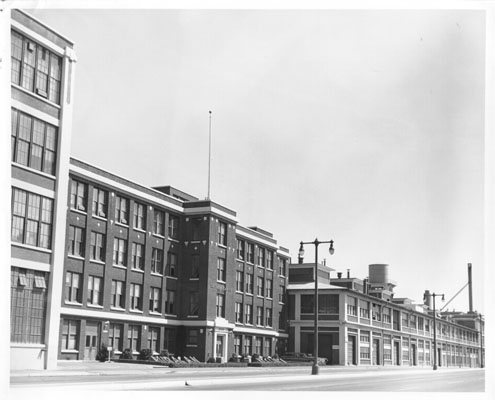
The next stop was 23rd and Bryant, at the Million Fishes artist collective, where a new project, the Access Cafe, was holding its first event. Here is the description of their efforts, take from their myspace page:
AccessCafe is an all-volunteer, nomadic restaurant that serves food on a donation and participation basis. We aspire to make healthy food and social space accessible to all.
Our goal is community outreach — to cultivate connections between the diverse populations that live within San Francisco’s Mission District. Further, AccessCafe aims to educate populations about affordable, nutritious, plant-based food. We seek to bolster wellness in people, relationships and communities by creating an atmosphere of nourishment, sharing and trust.
We offer community members the opportunity to prepare and facilitate AccessCafe, whether they assist promotions or solicit donations, whether they prepare tamales or arrange flowers. These are examples of non-monetary contributions. For those who wish to offer payment, AccessCafe does not have fixed menu prices. Instead, patrons pay what they believe the dining experience was worth. Larger contributions will help cover smaller contributions.
After the unexpected bonus of snacking on some delicious heated (and, we were told, dumpstered) bread, we headed to 23rd and Treat, where Tree, another old school San Franciscan, has started a weekly Free Farm Stand. At the stand, Tree gives away food that he and other local gardeners have grown, as well as starts for people who would like to garden. And smiles, of course.
Next snack break was perfectly planned to be Mission Pie, at 25th and Mission. Co-founder Karen Heisler explained how the project was started, its mission, its struggles (like the fact that the youth they started the project with--students from Mission High School--haven't wanted to leave their jobs at the shop, so they're having a hard time finding new employment for new students...I joke because this is more a success than a problem!) and we all left sated by strawberry rhubarb and a sense that we were contributing to something wonderful, all by buying a slice of divine pie!
Veritable Vegetable, close to Cesar Chavez and 3rd streets, was one of the few businesses that evolved out of the People's Food System and managed to survive the fallout. The others are Rainbow Grocery and Other Avenues Food Co-op. Bu Nygrens, who has worked for VV for 25 years and was one of our interviewees for the movie, gave us a tour of the facilities, talked about the role of values-driven distribution in the sustainable food system, and hooked up some really great, California-grown blueberries!
On the way to our final stop, the Alemany Farm, we noted the produce distribution district on Jerrold Ave, and the Alemany Farmer's Market, the oldest farmer's market in the city. Of course, the last leg, around Alemany toward the west, was the most difficult, with a gnarly wind and speeding motorists. But we made it! After I gave an intro to the farm, most people started heading out, not having expected the cold and fog after so many days of unbelievable hot weather.
Thanks again to everyone for participating! And remember, if you couldn't donate money on the ride, feel free to use the widget on this blog, or get in contact with me if you have some non-monetary help! Wear a helmet!
Sunday, May 4, 2008
Connections
Now, I may have to turn into a real blogger soon: there is just so much going on!
Here's a few updates on events both movie-related and (somewhat) personal.
1) Dan Sullivan, my new friend over at the Rodale Institute's newfarm.org, posted a little description of our project. Thanks Dan! Their website is an endless fount of Organic Farm info (and if you don't know the history of organic farming, Rodale plays a key role), so check it out!
2) I just returned from the 8th annual Food and Society Conference, held this year in Chandler, AZ. Put on by the W.K. Kellogg Foundation (the sustainable food movement's largest philanthropic supporter), the conference brings together 550 Executive Directors and assorted other "key players" in the "good food" scene. The event is invite-only, which means that someone out there thought I was worthy of taking part. I would like to write about this experience more, but I haven't the time right now and I think I still need a little time to let it sink in. Meanwhile, check foodandsociety2008.org
3) I never posted about my finalist status for the BR!CK award, a $10,000 grant given to youth (under 25) for doing something in their community. I also would need a lot more time to give full service to this story (which is ongoing: I have yet to find out if I won), but you can watch the one minute video I made to convince the people to give me the money here.
Here's a few updates on events both movie-related and (somewhat) personal.
1) Dan Sullivan, my new friend over at the Rodale Institute's newfarm.org, posted a little description of our project. Thanks Dan! Their website is an endless fount of Organic Farm info (and if you don't know the history of organic farming, Rodale plays a key role), so check it out!
2) I just returned from the 8th annual Food and Society Conference, held this year in Chandler, AZ. Put on by the W.K. Kellogg Foundation (the sustainable food movement's largest philanthropic supporter), the conference brings together 550 Executive Directors and assorted other "key players" in the "good food" scene. The event is invite-only, which means that someone out there thought I was worthy of taking part. I would like to write about this experience more, but I haven't the time right now and I think I still need a little time to let it sink in. Meanwhile, check foodandsociety2008.org
3) I never posted about my finalist status for the BR!CK award, a $10,000 grant given to youth (under 25) for doing something in their community. I also would need a lot more time to give full service to this story (which is ongoing: I have yet to find out if I won), but you can watch the one minute video I made to convince the people to give me the money here.
Saturday, May 3, 2008
Bay Area Backroads
I was recently featured on an episode of the long-running local travel show, Bay Area Backroads, covering urban farms. Along with People's Grocery and City Slicker Farms (our sister projects in the east bay), we were treated to some nice KRON coverage courtesy of the cheeky host who drives a Nissan.
Check it out!
Check it out!
Friday, April 25, 2008
On My Radio!
Aren't we special?
I feel like anyone who gets interviewed for the radio must be cool. Or at least thinks that they're cool enough that someone might want to hear what they have to say.
Well, that's us apparently, because we were interviewed twice on our trip!
First was Charles Myers for his show, Keepin' it Fresh, on KCBX in San Lois Obispo. You can hear the piece here. Charles isn't just a smart guy and a good interviewer. He's also the owner of the Big Sky Cafe, a local-food-buying, good-food-making restaurant.
Then, on the "last day" of the trip, the same day we interviewed A.G. Kawamura (CA Sect. of Ag), we were remotely patched in (courtesy of the Annex studio in Menlo Park) to Rory O'Dwyer's hosting of "Local Dirt", a KDVS (Davis) show on all things agriculture. You can't hear that on the internet--yet.
I feel like anyone who gets interviewed for the radio must be cool. Or at least thinks that they're cool enough that someone might want to hear what they have to say.
Well, that's us apparently, because we were interviewed twice on our trip!
First was Charles Myers for his show, Keepin' it Fresh, on KCBX in San Lois Obispo. You can hear the piece here. Charles isn't just a smart guy and a good interviewer. He's also the owner of the Big Sky Cafe, a local-food-buying, good-food-making restaurant.
Then, on the "last day" of the trip, the same day we interviewed A.G. Kawamura (CA Sect. of Ag), we were remotely patched in (courtesy of the Annex studio in Menlo Park) to Rory O'Dwyer's hosting of "Local Dirt", a KDVS (Davis) show on all things agriculture. You can't hear that on the internet--yet.
Highway 96
We left Arcata and headed into the mountains which, while stunning and immense, are not as large as I thought (barely 1000 feet!). We visited three farms before stopping to spend the night at Sandy Bar Nursery, an organic fruit tree nursery and cabin rental ranch—all in one!
First we saw George Stevens, who runs Synergy Seeds from his 4 acre holding, along with his two kids. George was a curious character, and (from what I have heard) has been around the sustainable/organic ag scene for a while. He told me that it was he, in fact, that introduced Paul Muller and Dru Rivers to the site that they later turned into Full Belly Farm (one of the success stories/heroes of the movement). There are lots of claims and rumors like this running around the movement, so maybe it’s ill-advised to spread them, but let’s just say that this guy has been around.
George showed us an UC-Davis developed low-tech seed winnowing device, which spit out chaff in a great flurry with the seemingly simple labored turning of a crank. George also spoke of the importance of saving seed, and gave us a simple explanation of the process he uses to save seed, which he then sells through the Seed Savers’ Exchange.
Then came Willow Creek. It was a large-for-the-area 15 acres of cover cropped straight tractor rows on fine alluvial soils near the river. Michael Peterson walked us up and down the main path holding his baby (who kept grabbing for the microphone placed on Michael’s shirt), trying not to squint too much in the sun. I think he interpreted a couple of my questions as accusations. Like when I asked if he foresaw any problems with the price of his manure (trucked in from a chicken farm down the coast) going up with fuel costs, he responded defensively, as if I were trying to criticize him for not being “sustainable enough”. Or when I tried to gauge whether there was potential to expand the local market for his produce (as currently he sells about half to distributors and half to the local Arcata/Eureka market). I’m not sure if these were bad questions, or he just didn’t appreciate some punks showing up on short notice asking these questions, but either way, thanks Michael for giving us the time! I wasn’t trying to be a jerk, I swear!
Last was Green Fire Farm, a joy to visit, albeit briefly and during the waning hours of the day. Linda talked to us about her life’s dream—to own and work a small piece of land with great soil and access to water, to participate in a local community—and how she’s living that dream at Green Fire. She may not have had all the answers to the world’s problems (find the answers to the world’s problems was not quite what I was setting out to do with this project, but somehow ambitious questions about “sustainable food systems” bring out reflection on a general concern for all those other elements of injustice and unsustainability in our society…and so our interview subjects sometimes feel pressed to try to figure it all out: a hefty task to say the least), but she sure knew how to run a farm. At this small scale, GFF revels in “gardening the farm” or “farming the garden”, and they do it very well from what I heard and saw. GFF is one of Food for People’s largest donors of produce.
We ended up that night at Sandy Bar Nursery, hoping to get the scoop on running a fruit tree nursery. Unfortunately, we got there pretty late, and with very little advance notice (my bad—I had forgotten to call them earlier), the couple who ran it (Mark and Blyth) could only offer us a place to stay…which was, obviously, appreciated and used to its fullest extent. We even made some oatmeal in the morning on the propane stove. We resolved to come back during the summer and see what the place looks like in full bloom.
First we saw George Stevens, who runs Synergy Seeds from his 4 acre holding, along with his two kids. George was a curious character, and (from what I have heard) has been around the sustainable/organic ag scene for a while. He told me that it was he, in fact, that introduced Paul Muller and Dru Rivers to the site that they later turned into Full Belly Farm (one of the success stories/heroes of the movement). There are lots of claims and rumors like this running around the movement, so maybe it’s ill-advised to spread them, but let’s just say that this guy has been around.
George showed us an UC-Davis developed low-tech seed winnowing device, which spit out chaff in a great flurry with the seemingly simple labored turning of a crank. George also spoke of the importance of saving seed, and gave us a simple explanation of the process he uses to save seed, which he then sells through the Seed Savers’ Exchange.
Then came Willow Creek. It was a large-for-the-area 15 acres of cover cropped straight tractor rows on fine alluvial soils near the river. Michael Peterson walked us up and down the main path holding his baby (who kept grabbing for the microphone placed on Michael’s shirt), trying not to squint too much in the sun. I think he interpreted a couple of my questions as accusations. Like when I asked if he foresaw any problems with the price of his manure (trucked in from a chicken farm down the coast) going up with fuel costs, he responded defensively, as if I were trying to criticize him for not being “sustainable enough”. Or when I tried to gauge whether there was potential to expand the local market for his produce (as currently he sells about half to distributors and half to the local Arcata/Eureka market). I’m not sure if these were bad questions, or he just didn’t appreciate some punks showing up on short notice asking these questions, but either way, thanks Michael for giving us the time! I wasn’t trying to be a jerk, I swear!
Last was Green Fire Farm, a joy to visit, albeit briefly and during the waning hours of the day. Linda talked to us about her life’s dream—to own and work a small piece of land with great soil and access to water, to participate in a local community—and how she’s living that dream at Green Fire. She may not have had all the answers to the world’s problems (find the answers to the world’s problems was not quite what I was setting out to do with this project, but somehow ambitious questions about “sustainable food systems” bring out reflection on a general concern for all those other elements of injustice and unsustainability in our society…and so our interview subjects sometimes feel pressed to try to figure it all out: a hefty task to say the least), but she sure knew how to run a farm. At this small scale, GFF revels in “gardening the farm” or “farming the garden”, and they do it very well from what I heard and saw. GFF is one of Food for People’s largest donors of produce.
We ended up that night at Sandy Bar Nursery, hoping to get the scoop on running a fruit tree nursery. Unfortunately, we got there pretty late, and with very little advance notice (my bad—I had forgotten to call them earlier), the couple who ran it (Mark and Blyth) could only offer us a place to stay…which was, obviously, appreciated and used to its fullest extent. We even made some oatmeal in the morning on the propane stove. We resolved to come back during the summer and see what the place looks like in full bloom.
Monday, April 7, 2008
Frank Fitzpatrick Video
It seems that Jesse had completed his edit of our interview with Frank Fitzpatrick, our friendly rancher buddy in Orange County, yet we did not post it.
Well, here it is! Frank's a funny guy, but he really knows his cattle.
Well, here it is! Frank's a funny guy, but he really knows his cattle.
Subscribe to:
Posts (Atom)